

.png)
Driving Healthcare Transformation from Within
For us, transformation did not begin with a single turning point or moment of epiphany. It happened gradually, through everyday experiences at work and a growing awareness that healthcare is constantly evolving. Whether we call it innovation, digitalisation or AI, it all comes down to one thing: being willing to embrace change.
Jeremy: For me, this means recognising that the healthcare landscape is constantly evolving. To keep pace, we need an adaptable mindset. We must be willing to embrace changes to our work, processes and systems, and be open to testing, iterations, failures and mistakes if we want to better the experience for patients, caregivers and staff alike.


As an Improvement Specialist in Quality Innovation & Improvement (QII), I work with project teams to frame problems, analyse data trends and review workflows. My role is to provide a refreshed perspective, challenge the norm and help teams think beyond traditional boundaries. Sometimes, people ask, “Why fix something if it ain’t broken?” As a hospital pharmacist by training, I understand the reality on the ground. Clinical work is demanding, and even when people want to improve things, finding the time and energy to do so is not always easy.

Angela: For me, the realisation has also been gradual. Nursing transformation must go beyond adopting new systems or processes. My aspiration has always been to create more seamless workflows, reduce unnecessary tasks, and bring greater joy and meaning to our nurses’ everyday work. As nurses face increasing demands, I see digital transformation as an important enabler to make care delivery more sustainable for both staff and patients.
In my role as an educator and administrator, I have the privilege of supporting capability building while influencing how change is translated into practice. This means looking beyond individual initiatives and considering how people, processes, technology and governance come together to improve outcomes. Growth is not always comfortable, and it takes time for teams to accept and own new ways of working. While we must bring people along thoughtfully, timing is also critical. If we wait too long, we risk losing the spark, momentum, and opportunity to innovate when the need is most relevant.
Our sparks came in different ways, but both led us to the same place: choosing to act.
Jeremy: I still remember a line from a children’s storybook I was reading to my son: “…it felt like the scariest thing he could do. But if you want things to change, you first have to change YOU.” Whatever the drivers may be, we all have to take that first step. Otherwise, nothing changes.
Angela: For me, the spark came from recognising a real need and choosing to act. Even small workflow improvements can make a meaningful difference to staff experience and patient care. Transformation is not about having all the answers from the start, but about having the courage to take the first step, test new ideas and learn along the way. Most importantly, we are not alone in this journey. It takes collective effort, shared learning and mutual support to turn small sparks into meaningful change.
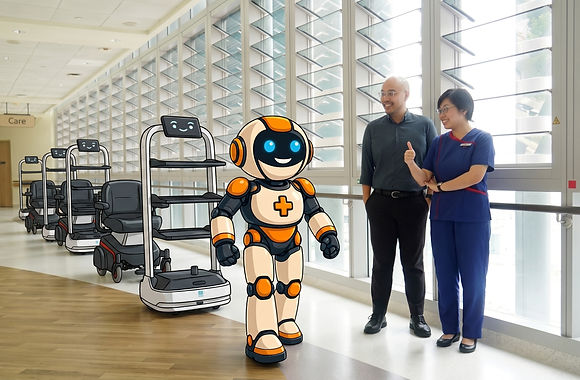
Recently, we spearheaded two robotics pilots: the Follow-Me wheelchair to facilitate multi-patient transport, and the Autonomous Mobile Robot (AMR) to deliver items within the ward. We started by framing the problem clearly: What are the pain points? What are we trying to solve? What are our measures of success? From there, we redesigned workflows and held regular check-ins to gather feedback and adjust the pilot scope where required.
One thing we learnt from these pilots is that mistakes are part of the process. Very rarely does a pilot work perfectly from day one. Iterations are not optional; they are part of the learning process. Bringing these devices in gives staff the opportunity to test feasibility and viability in a real-world setting. It lets them interact first-hand with the technology, and stirs curiosity and excitement. It also represents senior management’s commitment and willingness to allow staff the freedom and space to explore new ways of working.

Two things stood out for us: practicality and mindset. At a practical level, the pilots pushed us to rethink workflows, reduce low-value repetitive work, move from linear task execution to more coordinated workflows, and surface practical blind spots. At the mindset level, teams became more open to “try first, refine later”. Staff also started questioning why certain tasks were done manually, and whether a step could be removed, automated or shared.
Looking back, this journey meant more than just running pilots. It showed us how messy real change can be. Things do not move in a straight line. There are uncertainties, friction and moments where we question if the idea will work at all. But the process of testing, adjusting and learning is where the real value comes from.

The sky may not always be blue, but it can still be beautiful in its own way. Transformation is exciting, but it is not always smooth. Yet these experiences have shaped how we view leadership and change, bringing fulfilment not only from the outcomes achieved, but from the learning, relationships and collective growth along the way.
What we hope others take away is this: you do not need perfect conditions to start improving something. Challenge existing workflows, be comfortable with ambiguity, and do not wait for the perfect solution. Start with a small step, test it, listen, learn and refine along the way. This keeps us anchored on the purpose of every change: creating better experiences for our nurses, patients and the wider healthcare system.
Written by Angela Lim, Assistant Director, Nursing Administration, NTFGH, &
Jeremy Tan, Senior Process & Innovation Specialist, Quality, Innovation & Improvement (QII), NTFGH